
Retrospective
As I graduate from the IU Indianapolis Honors College, I define myself not merely as a programmer, but as a systems architect specializing in mechanical storytelling. My journey through the Media Arts & Science program has been a transition from mastering raw code to understanding how every player input serves as a sentence in a larger narrative. The Honors program has uniquely prepared me for the game industry by fostering a "professional savvy" that bridges the gap between technical realism and intentional player experience.
At the beginning
Looking back at my H200 showcase, my perspective on game design was largely foundational with some minor experiences. I viewed mechanics as a way for people to have fun, like getting a character to interact with an object so that the player receives positive feedback. My senior artifacts, however, demonstrate a "significantly changed perspective" where I now use simulation as a narrative device. I have moved from building 2D prototypes to mastering 3D environments and complex state-based synchronization, shifting my focus from "Does it work?" to "What does this experience teach the player?".
Artifact 1: Gluttonous Galaxy

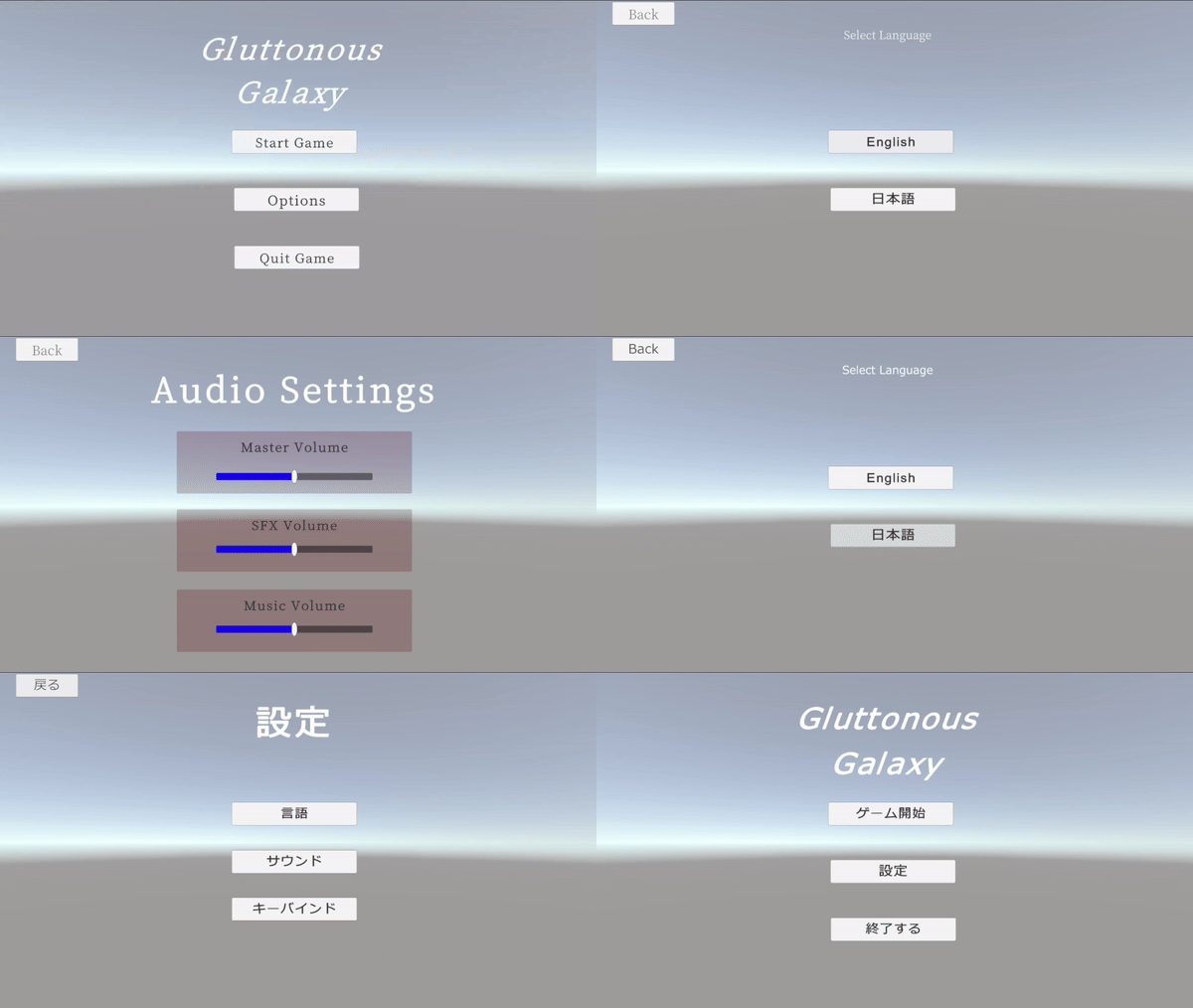
Gluttonous Galaxy represents a major milestone in my Honors experience, serving as a deep dive into 3D game systems through the lens of user-centric design and global localization
As the UI Designer, I was responsible for bridging the gap between complex 3D gameplay and player understanding. This required a transition from basic 2D menus to a responsive UI that maintained clarity amidst everything.
Beyond the technical programming, I served as the lead for Japanese Localization and managed the social media outreach for the Japanese audience. This dual role pushed me to think on how effective my wording was for outside audiences. I had to repeatably look up kanji on Jisho to make sure that the tone of our social media engagement was appropriate. My localization work on Gluttonous Galaxy is evidence that my work achieves the IUI Honors College goal of Civic-Mindedness by fostering a diverse, global community. By managing a social media account specifically for a foreign audience, I demonstrated a "civic-minded" approach to game development, recognizing that my role as a developer includes the responsibility of fostering a diverse, global community.


Project 2: Automated Acres
A defining moment in my professional development was my work on Automated Acres, a collaborative project between the Crane Naval Base and IU Indianapolis. This project challenged me to translate a high-level technological concept—Computer Vision—into an accessible, interactive educational experience for players. My primary task was building a dynamic quiz system and a randomization engine for "Minigame 3." This required a level of technical precision I had not yet touched in my previous coursework, as the system had to remain functional across varying difficulty stages and multiple screen sizes.
The most significant hurdle was the implementation of a Responsive UI. Through this project, I moved beyond simple static layouts to master anchor-based systems that ensured visual consistency regardless of device constraints. I also integrated complex Dialogue Animation synchronized with gameplay triggers, ensuring that the narrative and mechanics never overlapped or broke player immersion. Solving these issues taught me how to maintain a fair challenge while transitioning from set rounds to time-based pressure. My work on Automated Acres is evidence that my work achieves the IUI Honors College goal of developing strong communication and problem-solving skills. By correlating matching mechanics with actual Computer Vision concepts, I transformed a complex technological process into a narrative of pattern recognition. This experience was my first true taste of the professional game development process, requiring me to balance client needs with technical feasibility.
Project 3: Scrap Master (Honors Independent Study)
Where I stand today as a developer is best defined by my Honors Independent Study, Scrap Master. This project is the culmination of everything I’ve learned about "Mechanical Storytelling," representing my transition from a student following tutorials to a systems architect capable of building complex, meaningful worlds. In this roguelike deck-builder, I turned the game’s core resource—"Scrap"—into a narrative device representing the protagonist's fragmented memories.
This project required me to lead a full development cycle, transforming a raw, nostalgic concept into a polished, system-heavy reality. I focused on the synergy between the UI, the complex card logic, and the tactile "feel" of the mechanics to recreate the sensation of childhood imagination. As I navigated the technical hurdles of state-based synchronization and balance, I remember a guiding philosophy in Jason Schreier’s Blood, Sweat, and Pixels I read back in high school. Schreier writes:
"A video game is a localized miracle... The result of thousands of tiny, successful decisions made in the face of overwhelming odds."
This insight resonated deeply as I balanced intricate game loops with narrative depth. Schreier’s work highlights that professional game design is an act of sustained perseverance, a lesson I lived while debugging the complex logic required to make a single "invincible" card feel earned rather than broken.
Scrap Master aligns with the IUI Honors College goal of being an active participant in my intellectual experiences and reflecting on growth as a learner. By intentionally designing a subtle narrative that players discover through mechanics rather than just reading dialogue, I have demonstrated my emerging expertise in Narrative Systems Design. This Honors experience proves that I am ready to lead professional projects that bridge the gap between complex code and intuitive, emotional player experiences, ensuring that the "localized miracle" of the game is realized through both technical precision and artistic vision.
The Honors College has been the catalyst for my transformation from a student to a sophisticated intellectual. My perspective on my major has evolved from seeing it as a technical trade to recognizing it as a powerful medium for civic-minded storytelling and education. By synthesizing the problem-solving skills gained in Automated Acres with the systems architecture of Scrap Master, I have met the Honors learning goals and built a portfolio that demonstrates my readiness for the professional gaming industry. I graduate not just as a programmer, but as a world-builder who understands that every line of code is an opportunity to enhance the human experience.